
A new employee is starting on Monday.
HR needs to complete the paperwork. IT needs to prepare accounts and permissions. The hiring manager needs an onboarding plan. Finance may need additional details. And someone has to make sure everything is ready before the employee arrives.
There are plenty of opportunities for AI to help. One agent could prepare documents, another could gather the information required for account setup, and another could help the manager coordinate the first week.
But even if every agent does its job perfectly, the organization still needs to connect the work.
Who initiates each task? Which actions depend on others? How does one system know that another has finished? What happens when information is missing or an approval is delayed?
The challenge is to manage one process that involves agents, software systems, and people. That is what AI agent orchestration is designed to address.
What Is AI Agent Orchestration?
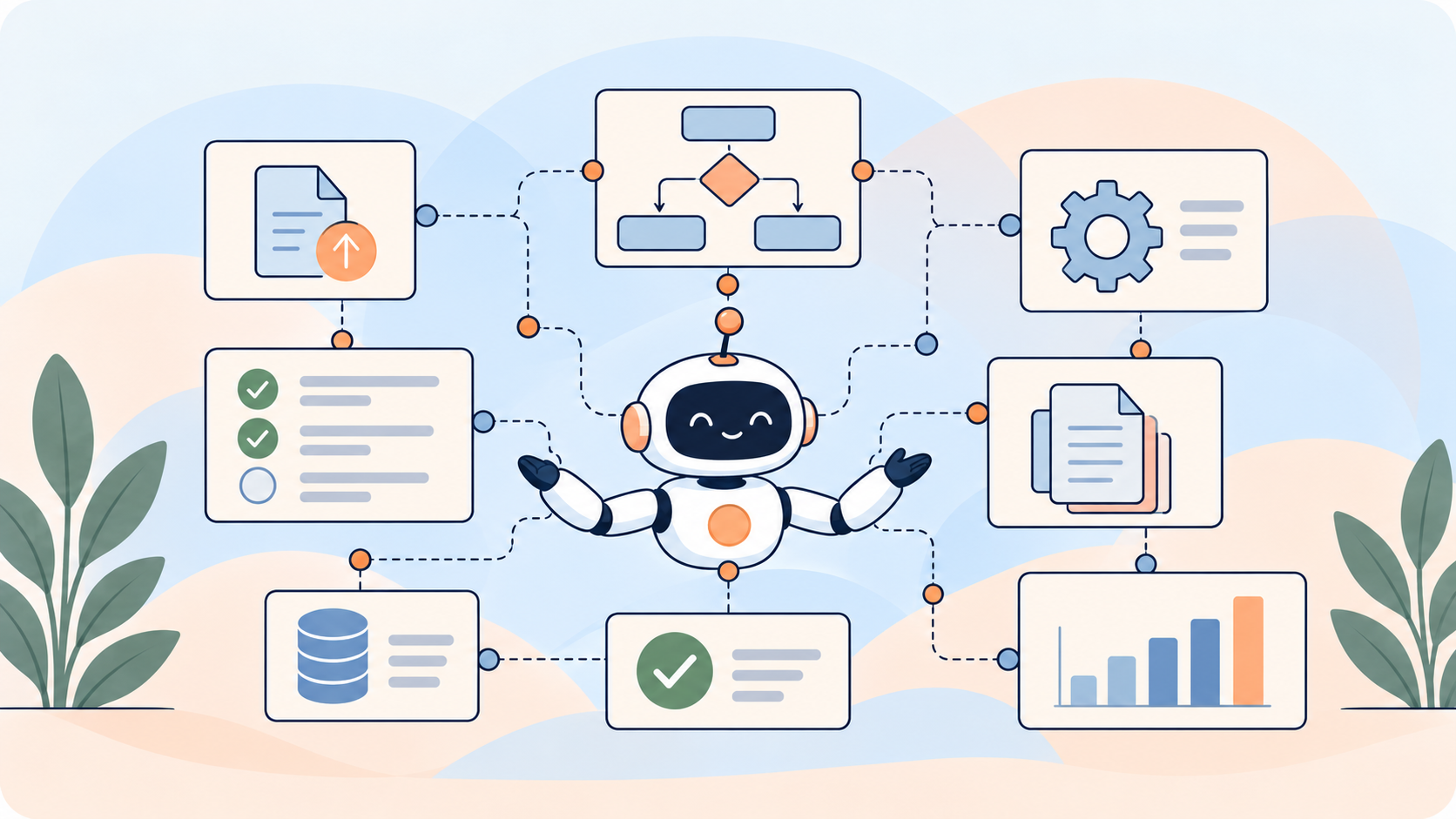
AI agent orchestration is the coordination of agents, software systems, and people within a shared workflow.
It defines how work progresses from one stage to another, what information each participant needs, which activities can happen simultaneously, and who has responsibility for the outcome.
An agent may be excellent at analyzing a document or preparing a recommendation. Orchestration makes sure that the output reaches the right next step, in the right context, with the appropriate controls.
The focus moves from individual tasks to the overall flow of work.
Design the Workflow Before Choosing the Agents
Consider our employee onboarding example.
The first step is to map the process as it operates today. What triggers it? What information is required? Which activities can begin immediately, and which must wait? Where are approvals necessary?
Once the workflow is clear, it becomes easier to determine what AI should do.
Some steps may benefit from an agent that interprets requests, processes documents, or works with variable information. Others may be better served by a conventional automation following a fixed set of rules. And some decisions should remain with the relevant employee or manager.
The goal is not to introduce as many agents as possible. It is to design a workflow that achieves the intended result reliably.
Make Progress Visible
Organizational processes rarely move forward without interruptions.
A document may be missing. An account request may be waiting for approval. The employee’s start date may change.
A well designed workflow needs to preserve its state. It should be possible to see what has been completed, what remains open, and which action is required next. It also needs rules for exceptions. Should a failed step be retried, referred to a person, or paused until missing information arrives? Without those decisions, even strong individual agents can leave the overall process unreliable.
This is especially important when work spans several systems or takes place over multiple days.
Microsoft’s Agent Framework documentation describes several orchestration patterns, including sequential execution, parallel execution, and contextual handoffs between agents. These patterns provide different ways to coordinate work, depending on how much flexibility and control a process requires.
Build Human Responsibility Into the Flow
AI can gather information, prepare actions, and move work forward within defined permissions. But responsibility for sensitive decisions must remain clear.
In employee onboarding, for example, an agent could prepare an access request and check whether required information is complete. Authorization to access a sensitive system would still come from the person responsible for granting it.
Human oversight works best when it is part of the workflow design, rather than something added after the system has already been built. That includes deciding which actions an agent may complete, which require approval, and what the system should do when an unusual situation arises.
Measure the Workflow, Not the Number of Agents
In onboarding, useful measures include whether required steps are completed on time, how often people need to intervene, and whether requests are left without an owner. The number of agents involved says little about the quality of the employee experience.
There also needs to be a person accountable for the outcome of the complete process, even when individual activities are automated. Clear operational ownership is part of orchestration design.
Individual agents can make specific tasks easier. Orchestration turns those capabilities into a coordinated way of working.
Its value becomes visible when work moves between people and systems without losing context, accountability, or control.
A capable agent can improve a task. The organization benefits when it can rely on the entire workflow.