
A project ends, the team moves on, and a few months later someone needs to understand a decision made along the way.
The documents are still there. The emails have been saved. The meeting notes probably exist somewhere. Yet the only reliable way to understand what was decided, and why, is to find someone who was in the room.
The missing piece is not necessarily the document. It is knowing which decision still applies, why it was made, and who has the authority to change it. As AI agents begin to participate in business processes, those distinctions need to become part of the context they can use.
What Is Organizational Memory?
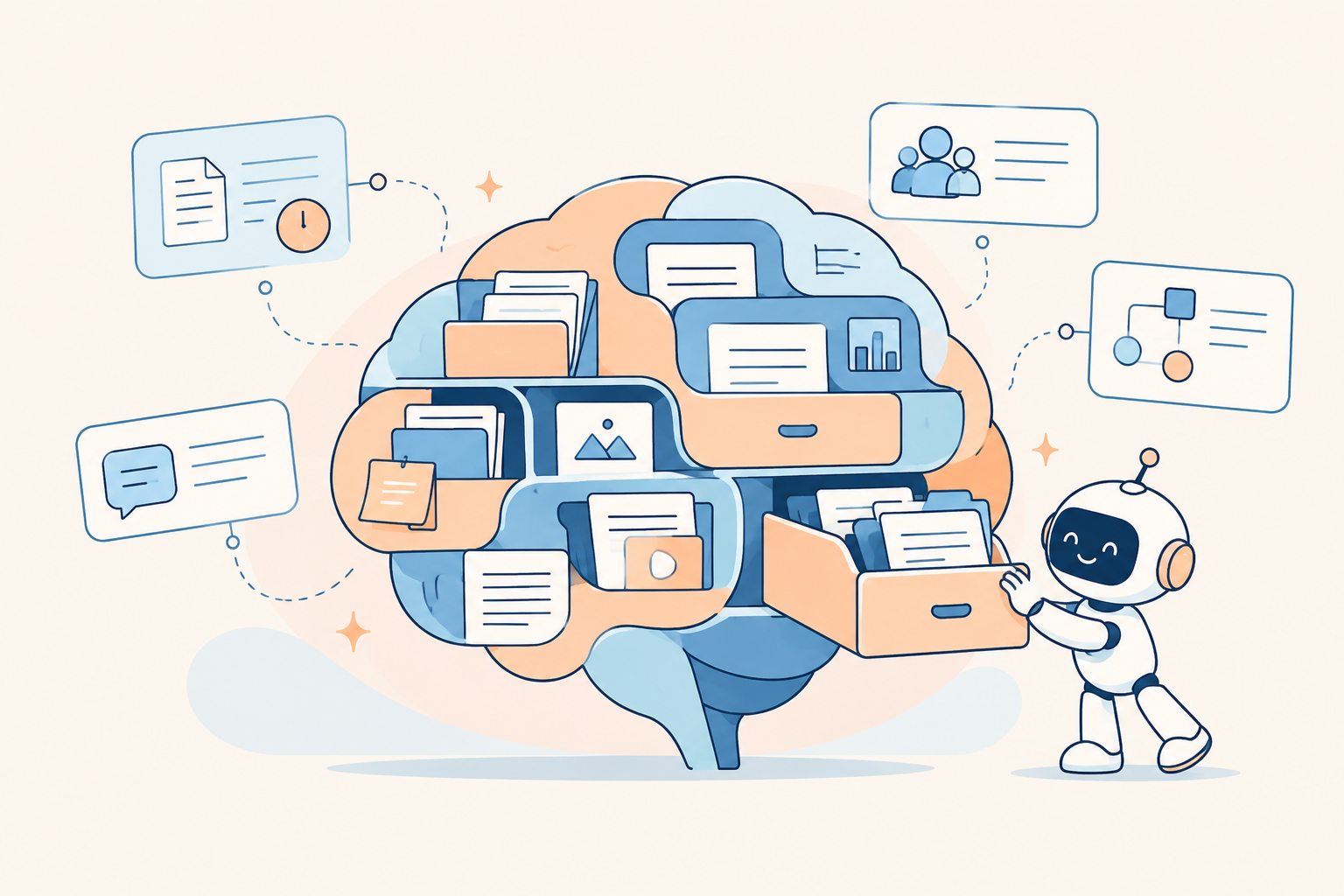
Organizational memory is an organization’s ability to preserve and reuse the knowledge, decisions, experience, and lessons it has accumulated over time.
It includes formal documentation, policies, and procedures. But it also includes the reasoning behind decisions, lessons from previous projects, customer relationships, and an understanding of what has worked in the past.
Some of this knowledge is well documented. Some is scattered across different systems. And a significant amount lives with the people who were involved.
The challenge is making that knowledge available when someone, or something, needs to use it.
Why Does Organizational Memory Matter More in the Age of AI?
Imagine an AI agent preparing to work on an existing customer project.
It can access the contract, review previous correspondence, and retrieve relevant documents. But does it know that the scope changed during the last meeting? That a proposal was discussed but never approved? Or that an earlier decision was later reversed?
Having access to information does not automatically mean understanding its current meaning.
As organizations give AI agents responsibility for more complex workflows, the ability to provide accurate, relevant, and current context becomes essential. An agent needs to know what has already happened, which decisions still apply, and what remains unresolved.
That requires organizational memory that goes beyond a collection of searchable files.
How Do You Build Organizational Memory?
Capture Decisions, Not Just Documents
Meeting summaries and project files are useful, but important decisions often get buried inside them. When a decision is made, capture what was agreed, why it was agreed, which process or project it affects, and who is responsible for the next step.
This gives future employees and AI agents a clearer picture of what actually happened, without having to reconstruct the entire conversation.
Give Information Context and Status
Not every piece of information carries the same authority. An idea discussed in a meeting is different from an approved policy. A customer request is different from a commitment the organization has made. And a decision that was correct six months ago may no longer apply.
Organizational memory needs to preserve these distinctions. Recording the source, status, date, and ownership of important information helps people and systems understand what they can rely on and what requires further verification. It should be clear whether an item is a draft, an approved decision, or a rule that has since been replaced.
Decide What Happens When Sources Disagree
Imagine an older policy stored in one system and a newer decision recorded elsewhere. An employee should not have to guess which one takes precedence, and neither should an AI agent. The organization needs an authoritative source for each type of decision, an owner who can update it, and a way to surface conflicts that remain unresolved. In some cases, stopping and asking for clarification is the right behavior.
Make Knowledge Available Within the Workflow
Knowledge becomes valuable when it can be used at the moment a decision or action is required.
Technologies such as Retrieval Augmented Generation (RAG) allow AI systems to retrieve relevant information from organizational sources and use it to inform their responses. But retrieval alone is not enough. The underlying knowledge needs to be accurate, current, accessible, and properly maintained.
The goal is to make the right context available within the work itself, rather than requiring people to search for it every time.
Test Whether the Memory Actually Works
Building organizational memory does not require documenting everything the organization has ever done. Start with one workflow where previous decisions regularly influence what happens next. Decide which decisions and events matter, who owns them, and how updates will be recorded.
Now give a colleague who was not involved the task of finding the current decision. Can they distinguish what was approved from what remains open? Can they see who resolves a conflict? Ask the same questions of an AI agent working with that information.
That test tells us more than the number of documents in the archive.
A stored document tells you what was written. Organizational memory tells you what applies now, and why.
When that distinction becomes part of daily work, people and AI systems can build on the organization’s experience instead of reconstructing it each time.